Home › Commercial Asphalt Resurfacing & Overlays
Extend the life of your pavement with commercial asphalt resurfacing in Norfolk, VA. We install overlays on sound parking lots and drive lanes to correct surface wear, improve appearance, and reduce long-term maintenance costs.
Precision Asphalt Norfolk provides professional commercial asphalt resurfacing throughout Norfolk, VA, Virginia and the surrounding area. Our licensed, insured crew delivers safe, clean, on-time work with a free estimate before anything begins. Call (757) 908-3635 or request your free quote.
Commercial Asphalt Resurfacing & Overlays for Norfolk Businesses
When asphalt on your commercial property starts to ravel, crack, or hold water, full replacement is not always the first move. In many Norfolk parking lots and private drives, commercial asphalt resurfacing and overlays give you a strong, clean driving surface without tearing everything out. Precision Asphalt Norfolk focuses on this middle ground, where we save the good base layers and rebuild the working surface on top.
Resurfacing is usually right for lots that look worn out on top but are still structurally sound underneath. Typical candidates in Norfolk are shopping centers on Military Highway, office parks around Downtown, industrial yards near the Port, and church or school parking lots that have alligator cracking but no big base failures. We help you decide between an overlay and full reconstruction by cutting small cores, checking base depth, and walking the site after a rain to see how water moves.
Our team explains what can realistically be saved and what must be dug out. If the base is pumping mud, if you have wide structural cracks that keep returning, or if utilities have caused major settling, we will tell you up front where resurfacing will fail so you are not pouring money over bad ground.
How Our Commercial Asphalt Resurfacing Process Works
On a commercial overlay project, the prep work matters more than the new asphalt itself. Precision Asphalt Norfolk follows a step-by-step process that keeps traffic disruption and long term risk in check.
First, we do layout and traffic planning. For busy Norfolk sites like medical offices or retail centers, we phase the project so you can stay open. We mark which sections will be closed each day, set up detours, and coordinate with your tenants or facility manager in writing.
Second, we handle surface repairs. Before any new layer goes down, we mill or sawcut high spots, remove loose material, and patch deeper failures. Potholes and base failures are cut out in rectangular sections, then rebuilt with compacted stone and hot mix asphalt in lifts. Long, wide cracks are cleaned, sometimes routed, and filled with hot rubber crack sealant so they do not reflect straight back through the overlay.
Third, we mill and feather where needed. At transitions to loading docks, ADA ramps, sidewalk crossings, and garage entries, we run a cold planer to remove existing asphalt to a precise depth. This keeps finished elevations flush with thresholds and prevents trip hazards or drainage dams.
Fourth, we clean and tack. The entire surface is swept with a mechanical broom and blown off so fine dust is gone. Then we apply a tack coat, an asphalt emulsion that glues the old and new layers together. Skipping tack is one of the main reasons overlays delaminate, so we are careful to get full, even coverage.
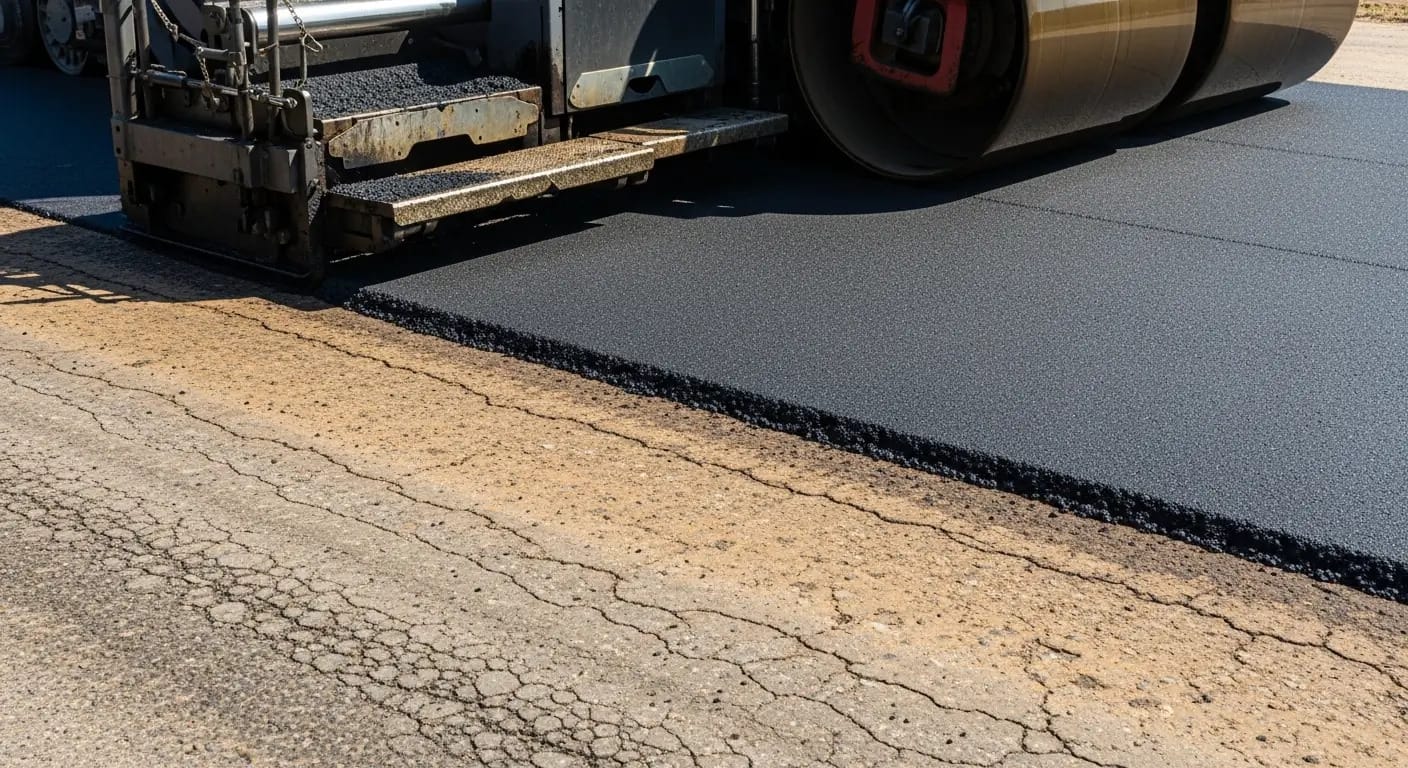
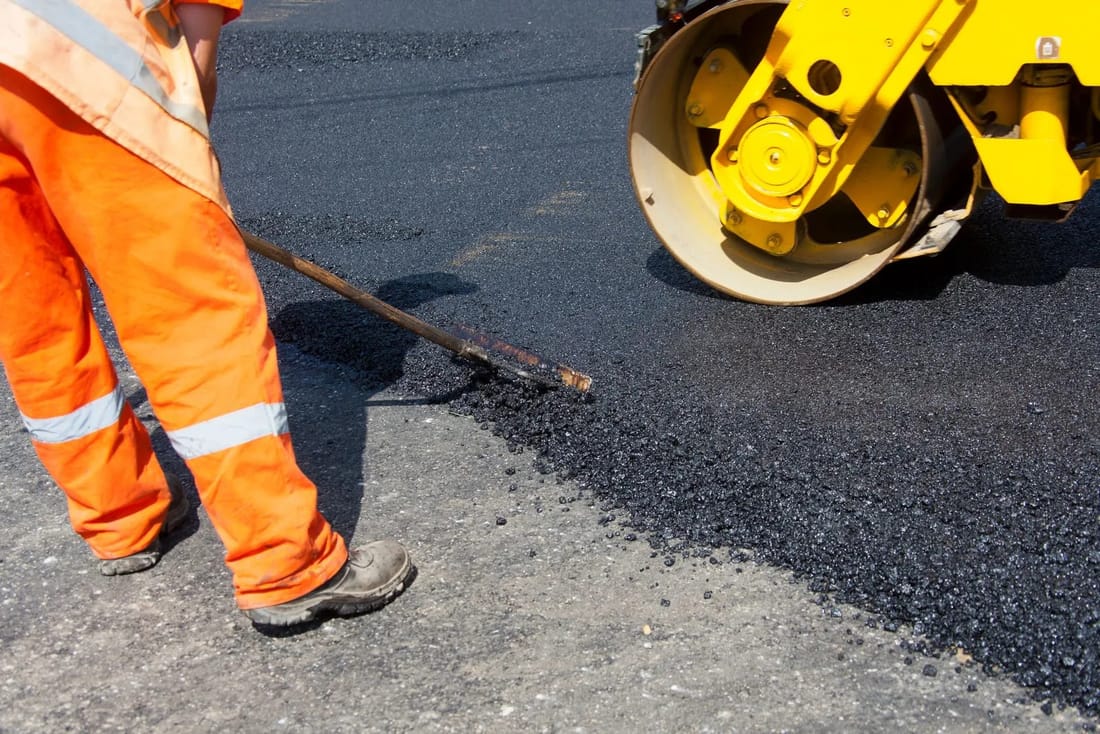
Finally, we place the new asphalt overlay. For most commercial lots we use a machine paver to place a uniform lift, usually 1.5 to 2 inches thick, then compact with steel and pneumatic rollers. We work the rollers while the mix is still in the proper temperature range for Norfolk’s typical weather so you get proper density without shoving or waves.
Material Choices, Thickness, and Design Options
Every commercial asphalt resurfacing job has a mix design behind it, not just a random truckload of blacktop. Precision Asphalt Norfolk works with Virginia-approved asphalt plants to select the right gradation and binder content for your use.
For standard parking lots with cars and light pickups, we typically install a surface course with a 9.5 mm or similar fine aggregate mix. This gives a smoother finish that is easier to stripe and plow if you use snow services. In heavy traffic lanes, dumpster pads, and delivery areas where box trucks or semis turn sharply, we may recommend a coarser or slightly thicker surface or even a localized deeper mill and inlay so rutting does not return.
Overlay thickness is not one size fits all. Thin overlays, around 1 inch, can refresh appearance but will not correct real structural issues. For most Norfolk commercial lots we target 1.5 to 2 inches of compacted thickness, which is enough to bridge minor surface flaws and give you a realistic service life. Where grades need to be changed for drainage, we can vary thickness, adding more build where we need to carry water to inlets and feathering down toward doorways.
We also design around your striping and traffic pattern. If you plan to reconfigure parking to add ADA spaces, EV chargers, or new loading zones, we adjust slopes and joint locations accordingly. Concrete features like curb islands, ramps, and dumpster pads are protected or temporarily sawcut and rebuilt if needed so the finished overlay works with them instead of trapping water against them.
For Norfolk properties near the Elizabeth River or low-lying tidal areas, we pay special attention to moisture in the existing base. In those locations we sometimes use an interlayer fabric or leveling course to help reduce reflective cracking and to separate wet base materials from the new overlay so the surface holds up longer.
Local Conditions, Water Issues, and Norfolk-specific Concerns
Norfolk’s coastal climate is tough on asphalt. Frequent rain, standing tidal water in low spots, and winter freeze-thaw cycles all push water into cracks and joints. If we ignore that, a new overlay can start to crack through in just a couple of seasons.
Before any resurfacing, Precision Asphalt Norfolk studies how water behaves on your lot. After storms, we look for birdbaths that hold water longer than 24 hours, settled trench patches from old utility work, and areas where runoff flows toward building entrances. These spots usually need more than a simple overlay. We may propose localized milling to regrade, replacement of soft subgrade, or adding additional inlets if ponding is severe and your budget allows.
Drainage and slope are especially important around Norfolk’s older brick buildings and waterfront facilities, where finished floor elevations are already low. Our crews shoot grades with a level so we can adjust overlay thickness instead of just following the existing waves. A small change in slope over 50 or 100 feet often solves chronic puddling without changing door thresholds.
Local rules also matter. Within Norfolk city limits, commercial resurfacing that alters drainage patterns, reduces existing parking counts, or changes access to a public street may trigger review by the city. We are not your engineer of record, but we regularly coordinate with civil engineers and can help you understand whether your planned work is straightforward maintenance or part of a larger site modification that needs drawings and approvals.
If your property is under an HOA, condominium, or retail center management association, we are used to presenting scope options, phasing plans, and color-coded site maps that boards can review. This makes it easier to get buy-in for a resurfacing project that may have to be broken into multiple fiscal years or phases.
Pricing, Scheduling, and What to Expect When You Hire Us
Commercial asphalt resurfacing costs in Norfolk are driven by more than square footage. When Precision Asphalt Norfolk prices an overlay, we look at total area, thickness of the new layer, amount of milling, quantity of base repairs, complexity of phasing, and plant distance. Lots with dozens of small islands, tight turns, or heavy oil contamination near loading docks take more handwork and cleanup time than open rectangles.
We start with a site visit, usually within a few days of your call. After you walk the lot with us and explain your operational needs, we send a written proposal that breaks out milling, patching, asphalt overlay, striping, and any concrete or drainage work. Whenever possible we give options, such as a minimum necessary repair overlay and a more robust plan with extra base work that adds life.
On scheduling, many Norfolk businesses prefer night or weekend work to avoid lost revenue. We routinely pave after-hours for retail centers, restaurants, and medical offices, provided nearby residents are not affected by noise restrictions. We can also phase the work so that half of the parking remains open while the other half is being milled and paved, then switch sides.
During construction, you can expect a clear daily schedule, temporary signage, and barricades that are actually monitored, not just dropped and forgotten. We coordinate with towing companies if necessary to clear vehicles from scheduled work areas, and we keep emergency access paths open at all times.
Once the overlay is complete and compacted, we typically recommend keeping traffic off for 24 hours for light passenger vehicles and a bit longer for heavy trucks, depending on temperature and mix design. Striping is usually completed within a day of paving. We also talk through ongoing maintenance such as crack sealing and sealcoating schedules so you can plan a realistic life cycle budget instead of reacting when the surface fails again.